Louis Smith


BEN DEARNLEY
Louis Smith
The turso of Louis Smith was crafted by Ben Dearnley during a 3 year run-up to the 2012 London Olympic Games. He focused his main practice as a sculptor on capturing as many Olympic and Paralympic athletes as he could for his show, “The Avenue of Champions”, which was to be at Salisbury Cathedral during the whole of that summer and was attended by over 100,000 visitors from all over the world.
Dearnley wrote, Louis Smith, was one of the youngest of my subjects I selected and after his success at the 2008 Beijing Olympics and he was one of Team GB’s hot stars of that time. I asked him if he would like to become part of my sculpture show I had planned for 2012 and he agreed. I remember travelling to his training ground to take my life cast from his torso (as all my works for that show were focused on uniting both Olympic and Paralympic athletes in that way), and after watching him in practice and taking photos I was sure we could make a piece of work together which would stand the test of time. I aimed to capture a unique aspect of each athlete I worked with, and Louis, and his work on the pommel horse, provided its own challenge for us both.
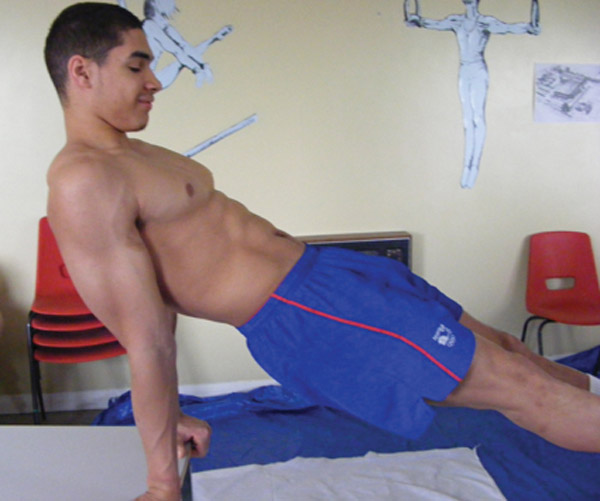
The thing about this sculpture is that having chosen the moment I wanted to capture (the midway point of a straight body circles routine – a fully extended leg spin) I had to get him to replicate the exact pose as if in mid-spin, and hold it. This was a huge ask for him as all his work is in a flow of motion, and to be asked to hold one moment for an extended time like that was incredibly difficult. I worked as fast as I could to get the life cast from his torso but he would have to hold that position for at least ten minutes!
We had set up an impromptu studio in the changing rooms at the training ground and after some trial and error we found a table and a few blocks we could use as props to get as close to the frozen moment in time I was after. His cast was a great success because of his determination for getting the best out of this session was 100%. However, I also realised that I had pushed him well beyond any reasonable comfort zone.
In the end, once the final bronze was cast from the finest gunmetal bronze, I decided to give the final patination of the sculpture that deep gold colour to reflect the feeling that in all our minds and hearts Louis Smith was a true champion, whatever the outcome of the London Games was to be. I feel honoured to have been able to work with all the athletes selected for my Avenue of Champions series and especially with Louis, who went on to not just win medals in 2012 but also to break new records as a British gymnast and help Team GB become the most successful UK Olympic team of its time.
We used to live next to an elderly couple who I was very fond of, and I used to visit and share each new sculpture I had made with them over a cup of tea. Sadly, Molly (the wife) was diagnosed with cancer in her late 80’s and she was only given a few months to live… however, she ended up living for another full year and a half. She loved the exchanges we had and fully engaged with each piece I brought to her to see. Anyhow, and I know she would not mind me sharing this with you, she put it to me that the joy she had from our exchanges was a contributory factor to her ‘extra’ time as it gave her so much to look forward to seeing/handling the next piece of sculpture. Last year she lost her sight, and that gave us an unusual opportunity to each learn something new. For her, it was a challenge to “read” the sculpture with her hands and use her mind’s eye, and for me, it was helpful to see my own work from that different perspective. Sometimes she would get a piece spot on, and other times her reading was totally based on her intuitive response. She was not necessarily “getting” the same reading as a sighted person, but her reading was no less valid.
So I would have to say that, as with all art, the experience or language is subjective. No two readings are exactly the same as we each bring our own unique way of looking at things to the piece of art we are viewing. The actual “language” generated are the unspoken words which are transmitted from the object of art to the viewer. These are personal to the viewer and, although they might be similar to someone else, they are the artist’s “gift” to that individual person.
We need to be fully open to the world of abstract sculpture, for it is a product of ‘our time’ and one that has its place. It is not always easy to read, but often, once we view a piece, we do find that there is a response to it that comes to us. Therefore, the sculpture has evoked in us a form of communication, it has its own language, and if we are to understand it, we must put in some effort to learn more about the subject, its creator, their place and history, and the context of the piece in the viewing location. After all, we cannot expect to be able to write an essay of 1000 words without having first learnt the letters of the alphabet. I believe every sculptor is inherently attached to his/her work as it is a direct creation of their consciousness, yet they will still have to detach themselves from it once it has been finished and leaves the studio. Then it takes on its own life and tells something of the narrative that the sculptor has imbedded within its core essence”1.
Please email me if you have more information on the sculpture Louis Smith you would like to share. Thank you.
References:
1. Dearnley, B (2021) Louis Smith [email]
Figure 1: Dearnley, B (nd) Sculpture of Louis Smith [image]
Figure 2: Dearnley, B (nd) Louis Smith taking postion [image]